

From Momentum to Implementation: Why the 2026 Dushanbe Water Conference Matters
As global attention turns to water and climate in cities such as Geneva, Paris, and New York, one message is becoming increasingly clear: the challenge is no longer to place water on the international agenda—it is to deliver results.
Over the past decade, water has steadily risen as a global priority. The United Nations General Assembly’s proclamation of the International Decade for Action “Water for Sustainable Development” (2018–2028) marked a turning point, providing a political framework to elevate water across development, climate, and environmental processes. That momentum culminated in the UN 2023 Water Conference, co-hosted by Tajikistan and the Netherlands, which mobilized an unprecedented level of engagement and launched the Water Action Agenda—now comprising more than 800 voluntary commitments.
Yet despite this progress, the global water crisis remains acute. Billions of people still lack access to safe drinking water and sanitation, while nearly a tenth of the world’s population lives under conditions of high or critical water stress. Climate change is intensifying these pressures, disrupting hydrological cycles and increasing the frequency of floods and droughts.
The question now facing the international community is not one of awareness, but of implementation.
It is precisely at this juncture that the Fourth High-Level International Conference on the International Decade for Action “Water for Sustainable Development”, to be held in Dushanbe from 25 to 28 May 2026, takes on strategic importance.
Positioned between the UN 2023 Water Conference and the upcoming 2026 UN Water Conference, the Dushanbe Conference is designed to act as a bridge between commitments and delivery. It will provide a platform not only to review progress, but to identify practical solutions, strengthen partnerships, and accelerate action toward Sustainable Development Goal 6.
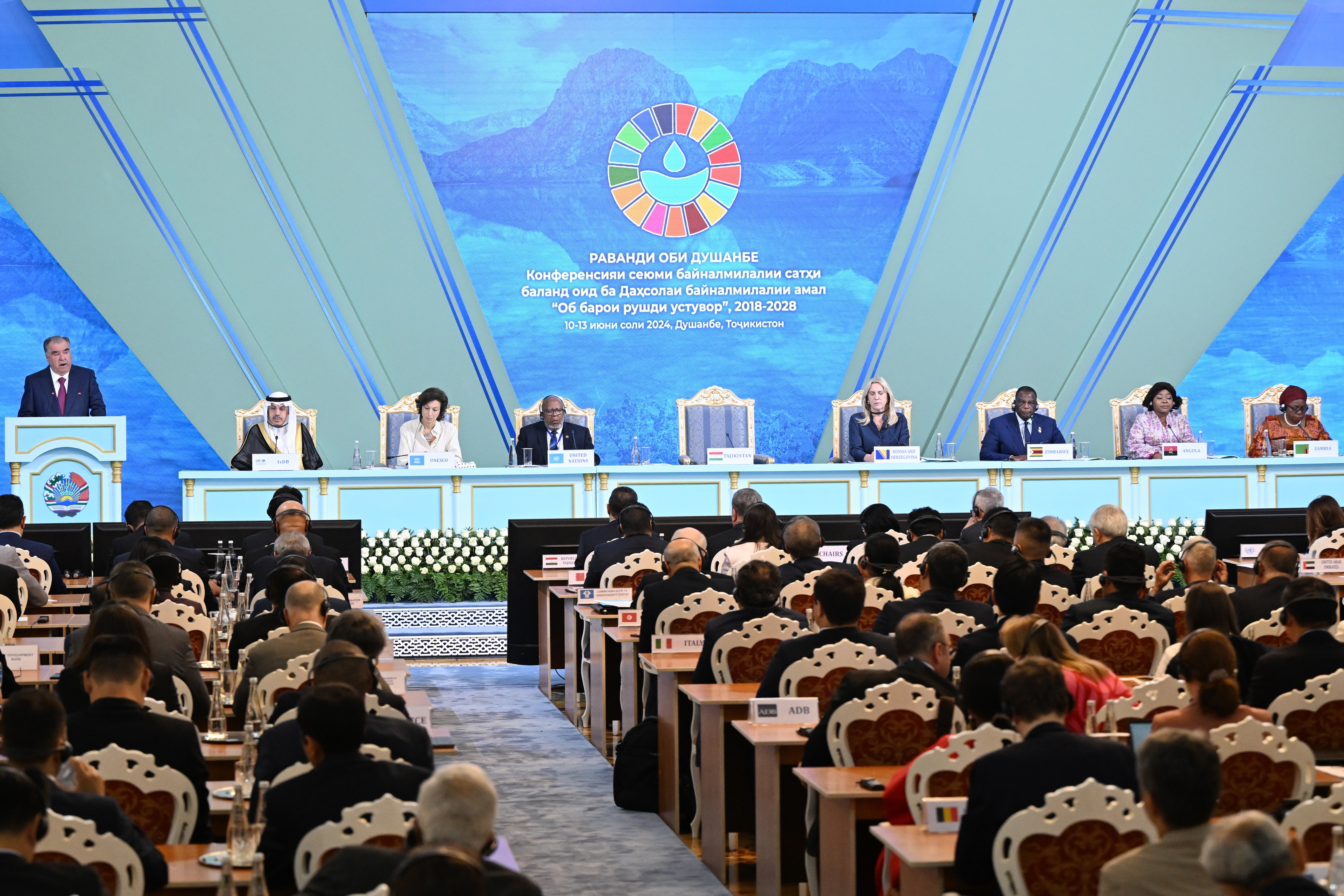
At the heart of this effort is the Dushanbe Water Process—a series of biennial conferences initiated by Tajikistan in cooperation with the United Nations. Over time, this process has evolved into a key mechanism for maintaining political momentum and ensuring follow-up to global water commitments. Previous conferences have already played a role in shaping international agendas, including contributing to the themes and outcomes of the 2023 UN Water Conference.
The 2026 edition builds on this legacy but reflects a clear shift in emphasis. While earlier phases focused on agenda-setting, the current phase is about translating commitments into measurable outcomes.
This focus is reflected in the Conference’s structure. Rather than negotiating new frameworks, discussions will center on six priority areas aligned with global water governance: water access and human rights, economic development and the water-energy-food nexus, environmental sustainability, transboundary cooperation, the role of water in multilateral processes, and financing and investment.
These themes mirror the complexity of today’s water challenges. Water is no longer simply a sector—it is a cross-cutting issue that links climate, food systems, energy, health, and economic development. Addressing it requires integrated approaches that move beyond institutional silos.
Equally important is the Conference’s role in shaping future processes. It will serve as a preparatory platform for the 2026 UN Water Conference, helping to align priorities and inform its interactive dialogues. At the same time, it will initiate informal consultations for the 2028 UN Water Conference, which will mark the final review of the Water Action Decade and assess global progress.
This forward-looking dimension is critical. With the 2030 Agenda approaching its final phase, the international community is already beginning to consider what comes next. Water—given its centrality to sustainable development—is likely to play a defining role in any post-2030 framework.
Another distinguishing feature of the Dushanbe Conference is its multi-stakeholder character. Beyond government representatives, it brings together international organizations, financial institutions, scientists, civil society, and the private sector. Dedicated forums for youth, women, indigenous communities, and other groups aim to ensure that water governance is both inclusive and grounded in real-world experience.
This approach reflects a broader lesson from recent years: water challenges cannot be addressed by governments alone. They require coordinated action across sectors, disciplines, and levels of governance.
The Conference also places strong emphasis on tracking progress. By providing a platform to report on commitments under the Water Action Agenda, it helps address one of the persistent weaknesses of global processes—the gap between pledges and implementation.
At the same time, the broader environmental context cannot be ignored. The International Year of Glaciers’ Preservation 2025 and the launch of the Decade of Action for Cryospheric Sciences have highlighted the deep interconnections between climate and water. Glacier retreat, in particular, is altering river systems and water availability in many regions, reinforcing the urgency of integrated approaches.
In this regard, institutions such as the World Meteorological Organization and UNESCO play a critical role in strengthening the scientific basis for decision-making. Their work underscores the importance of linking science with policy—an objective that is increasingly reflected in global water governance.
Ultimately, the significance of the 2026 Dushanbe Water Conference lies not in its format, but in its timing.
It takes place at a moment when global awareness of water challenges is high, political commitments are in place, and institutional frameworks are evolving. What is needed now is acceleration—turning commitments into action, and action into impact.
Whether the international community can meet this challenge will depend not only on high-level declarations, but on the ability to sustain cooperation, mobilize resources, and implement solutions at scale.
In that sense, Dushanbe is more than a conference venue. It is a test of whether multilateralism on water can move from ambition to delivery.
Because ultimately, the future of water governance will not be defined by what is agreed—but by what is achieved.
